


Solar Safety Handrails for Industrial Rooftops | Sugatu
Date: 19-11-2026 | Author: Sugatu
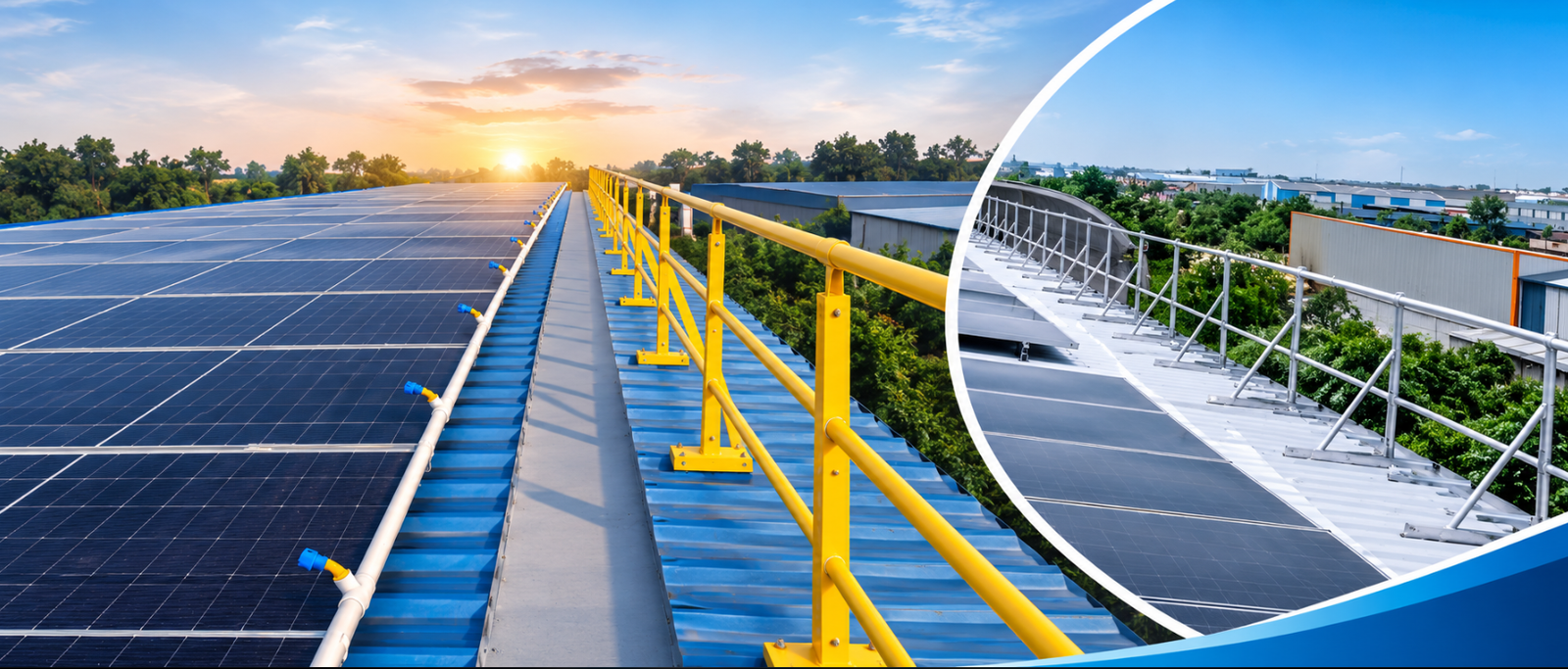
Solar Safety Handrails for Industrial Rooftops: Improving Rooftop Protection, Accessibility and Maintenance Safety
Introduction
India's solar energy industry continues to expand as commercial buildings, manufacturing facilities, warehouses and industrial establishments increasingly adopt rooftop solar power systems. While solar panels, mounting structures and electrical components are essential for energy generation, rooftop safety infrastructure is equally important for installation and long-term maintenance.
Industrial rooftops often contain extensive solar panel arrangements, electrical equipment, maintenance pathways and elevated working areas. Technicians working in these environments may face risks associated with roof edges, changes in elevation and restricted access routes.
Solar safety handrails are an important component of rooftop safety infrastructure. They provide physical barriers around designated rooftop areas and can help reduce fall risks when correctly designed and installed.
Sugatu Infra Pvt. Ltd. offers solar safety handrail solutions for commercial and industrial rooftop applications, supporting safer access and organised rooftop maintenance.
What Is a Solar Safety Handrail?
A solar safety handrail is a protective railing system installed along designated rooftop edges, access routes, maintenance platforms or other elevated areas where fall protection may be required.
These systems provide a physical barrier between personnel and potential fall hazards. Depending on the design, rooftop handrails may also help guide movement along designated maintenance routes.
Solar safety handrails are commonly considered for industrial buildings, warehouses, commercial rooftops and solar installations requiring regular inspection or maintenance.
A properly designed handrail system should consider structural stability, mounting compatibility, environmental conditions and applicable safety requirements.
For rooftop solar projects, handrails may be integrated with maintenance walkways and other fall protection arrangements to create a coordinated rooftop access system.
Why Are Solar Safety Handrails Important?
Solar installations require periodic inspection, cleaning and maintenance throughout their operating life. Workers may need to access solar modules, mounting structures, electrical connections and other rooftop equipment.
On large industrial rooftops, these activities may involve movement near roof edges, access openings and other elevated areas.
Installing suitable rooftop safety handrails can help improve protection in designated locations.
1. Improved Rooftop Fall Protection
Working at height presents significant safety risks, particularly around unprotected roof edges.
Solar safety handrails provide a physical barrier that can help prevent accidental falls when the system is appropriately designed for its intended application.
The effectiveness of a handrail depends on its structural design, installation quality, anchorage and compliance with applicable safety requirements.
2. Safer Maintenance Access
Solar maintenance personnel may need to move between different rooftop areas during inspections and servicing.
Handrails installed alongside suitable access routes or maintenance platforms can provide additional protection where required.
This is particularly relevant for industrial solar projects with extensive rooftop infrastructure and regular maintenance requirements.
3. Better Organisation of Rooftop Working Areas
Industrial rooftops may contain ventilation equipment, skylights, electrical installations and other infrastructure.
Safety handrails can help define protected working zones and designated access boundaries.
When integrated into the overall rooftop layout, these systems can contribute to a more organised maintenance environment.
4. Support for Long-Term Rooftop Safety Planning
Rooftop safety should be considered during the initial solar project planning stage rather than only after installation.
Identifying areas that require protective barriers can help project teams plan suitable access arrangements.
A coordinated approach may include handrails, solar walkways, safety lines and other appropriate fall protection measures.
Types of Solar Safety Handrails
Different rooftop environments require different handrail configurations. The appropriate system depends on roof design, structural conditions, access requirements and project specifications.
Aluminium Solar Safety Handrails
Aluminium handrails are used in various rooftop and industrial applications because of their relatively low weight and corrosion resistance.
Their lightweight construction can make them suitable for certain rooftop installations where additional structural loading must be carefully considered.
However, material selection alone does not determine the suitability of a handrail system. Structural strength, connection design and applicable safety requirements must also be evaluated.
C-Channel Safety Handrails
C-channel profiles can be used as structural components in suitable handrail configurations.
Their geometry may provide practical connection and mounting options depending on the system design.
For industrial rooftop projects, the suitability of C-channel handrails depends on the material specifications, structural arrangement and intended application.
Square-Tube Safety Handrails
Square-tube handrails are another configuration used in industrial and commercial safety railing systems.
These systems may provide a straightforward structural arrangement for designated rooftop areas and maintenance platforms.
The appropriate dimensions, material thickness, connection details and anchorage should be determined according to the project's engineering requirements.
Solar Safety Handrails for Industrial Rooftops
Industrial rooftop solar installations frequently cover large areas, creating a need for planned maintenance access and appropriate safety infrastructure.
Factories, warehouses, manufacturing plants and commercial facilities may have different roofing systems, including metal-sheet roofs and reinforced concrete rooftops.
The selection of a safety handrail system should account for these structural differences.
For metal rooftops, particular attention should be given to the roof profile, supporting members and anchorage arrangements.
For concrete rooftops, handrail installation may involve different fixing methods and structural considerations.
In both cases, the system must be designed to withstand the applicable loads and environmental conditions.
Solar Handrails and Roof Maintenance Walkways
Solar maintenance walkways and safety handrails serve complementary purposes.
A solar walkway provides a designated surface or route for maintenance personnel to move across suitable rooftop areas.
A safety handrail provides a protective barrier where required, such as along exposed edges or designated elevated working areas.
Combining suitable walkway and handrail systems can help create a more organised rooftop maintenance arrangement.
For large commercial and industrial solar installations, this approach may improve accessibility while addressing relevant fall hazards.
However, not every walkway requires a handrail, and not every rooftop hazard can be addressed through handrails alone. The appropriate combination of safety measures should be determined through a site-specific risk assessment.
Important Factors When Selecting Solar Safety Handrails
Choosing a suitable solar safety handrail involves several technical and practical considerations.
Roof Compatibility
The first consideration is the type of rooftop on which the handrail will be installed.
Metal-sheet roofs, standing seam roofs and concrete rooftops may require different mounting and anchorage arrangements.
The selected system should be compatible with the existing roof structure.
Structural Strength
A safety handrail must be capable of resisting the loads applicable to its intended use.
The supporting structure, connection details and anchorage points should be evaluated by qualified professionals.
Structural suitability is particularly important for industrial rooftops where roof construction and supporting members may vary.
Material Durability
Rooftop safety systems are exposed to sunlight, rainfall, temperature changes and other environmental conditions.
Material selection should consider corrosion resistance, protective finishes and long-term exposure.
For coastal or highly corrosive industrial environments, additional material compatibility considerations may be necessary.
Installation Requirements
Proper installation is essential for the effectiveness of a safety handrail.
Fixing methods, anchorage details, spacing and structural connections should follow the approved design and applicable requirements.
Incorrect installation can compromise the intended protective function of the system.
Maintenance and Inspection
Safety handrails should be inspected periodically according to the applicable maintenance requirements.
Inspections may include checking for corrosion, damaged components, loose connections and other signs of deterioration.
A suitable maintenance plan helps identify issues that may affect the system's continued performance.
Solar Safety Handrails vs Solar Safety Lines
Although both systems are associated with rooftop fall protection, they serve different functions.
A solar safety handrail provides a physical barrier intended to help prevent falls in designated areas.
A solar safety line is part of a personal fall protection arrangement and is used with compatible equipment, such as a suitable harness and connecting system.
Handrails may provide collective protection for personnel in appropriately designed areas, while safety lines depend on correct personal protective equipment, anchorage and user procedures.
The choice between these systems depends on the work environment, hazard assessment and applicable safety requirements.
Some projects may require a combination of different protective measures.
Common Mistakes to Avoid During Handrail Installation
One common mistake is selecting a handrail system without evaluating the structural capacity of the rooftop.
Another is using mounting arrangements that are incompatible with the existing roof profile.
Incorrect anchorage, unsuitable materials and inadequate attention to environmental exposure can also affect system performance.
Additionally, installing handrails without considering the overall rooftop access layout may leave important hazards unaddressed.
Project teams should avoid treating safety handrails as decorative rooftop accessories. These systems must be designed and installed as functional safety infrastructure.
How to Choose a Solar Safety Handrail Supplier in India
Selecting a reliable solar safety handrail supplier is important for solar EPC companies, contractors and industrial project developers.
Businesses should consider product specifications, material quality, available configurations and compatibility with the intended installation.
Technical documentation and information about the system's structural requirements are also important.
Suppliers offering complementary rooftop infrastructure products may help project teams coordinate procurement requirements more effectively.
Sugatu Infra Pvt. Ltd. offers solar safety handrail products alongside rooftop maintenance walkways, safety lines, mounting structures and other solar installation accessories.
Why Choose Sugatu for Solar Safety Handrail Solutions?
Sugatu Infra Pvt. Ltd. provides a range of rooftop safety and solar infrastructure products for commercial and industrial applications.
Its portfolio includes solar safety handrails, rooftop maintenance walkways, solar safety lines, mounting structures, mini rails, clamps and other installation accessories.
These product categories support different requirements associated with rooftop solar installation, maintenance accessibility and safety infrastructure.
For solar EPC companies, contractors, installers and project developers, selecting suitable safety products is an important part of planning rooftop solar projects.
Sugatu offers access to multiple rooftop infrastructure product categories to help customers explore solutions according to their project requirements.
Visit www.sugatu.in to learn more about Sugatu's solar safety handrails and rooftop infrastructure products.
Frequently Asked Questions
1. What is a solar safety handrail?
A solar safety handrail is a protective railing system installed around designated rooftop areas to help reduce fall risks and provide physical barriers for personnel working at height.
2. Why are safety handrails important for rooftop solar installations?
Safety handrails help protect personnel working near rooftop edges and other designated elevated areas. They can form part of a broader rooftop safety and maintenance access strategy.
3. Which material is suitable for rooftop safety handrails?
Aluminium and other appropriately specified structural materials may be used for rooftop safety handrails. The suitable material depends on environmental conditions, structural requirements and the intended application.
4. Can solar safety handrails be installed on metal roofs?
Yes, suitable handrail systems can be installed on certain metal roofs using compatible structural mounting arrangements. Roof capacity and anchorage requirements must be evaluated before installation.
5. What is the difference between a solar walkway and a safety handrail?
A solar walkway provides a designated route for rooftop movement, while a safety handrail provides a protective barrier around designated areas where fall hazards may exist.
6. Are rooftop safety handrails mandatory for industrial solar projects?
Requirements depend on applicable regulations, the rooftop configuration, work activities and the identified hazards. A site-specific safety assessment is necessary to determine the required protective measures.
7. Do solar safety handrails require maintenance?
Yes. Rooftop safety handrails should be inspected and maintained according to their design requirements, environmental exposure and applicable safety procedures.
8. Where can I find solar safety handrail suppliers in India?
Solar EPC companies, contractors and industrial facility owners can explore suppliers such as Sugatu Infra Pvt. Ltd. for solar safety handrails and related rooftop infrastructure products.
Conclusion
As rooftop solar installations expand across India's commercial and industrial sectors, the importance of suitable rooftop safety infrastructure continues to grow.
Solar safety handrails provide physical barriers that can help reduce fall risks and support safer access around designated rooftop areas.
Selecting an appropriate handrail system requires consideration of roof compatibility, structural strength, material durability, installation requirements and long-term maintenance.
When integrated with suitable solar walkways, safety lines and other protective measures, handrails can contribute to a coordinated rooftop safety strategy.
Sugatu Infra Pvt. Ltd. offers solar safety handrails and complementary solar infrastructure products for different commercial and industrial applications.
Looking for solar safety handrail solutions for your rooftop project?
Visit www.sugatu.in to explore the product range and discuss your requirements.
