


Solar Mounting Structures & Rooftop Safety Systems in India | Sugatu
Date: 13-10-2026 | Author: Sugatu
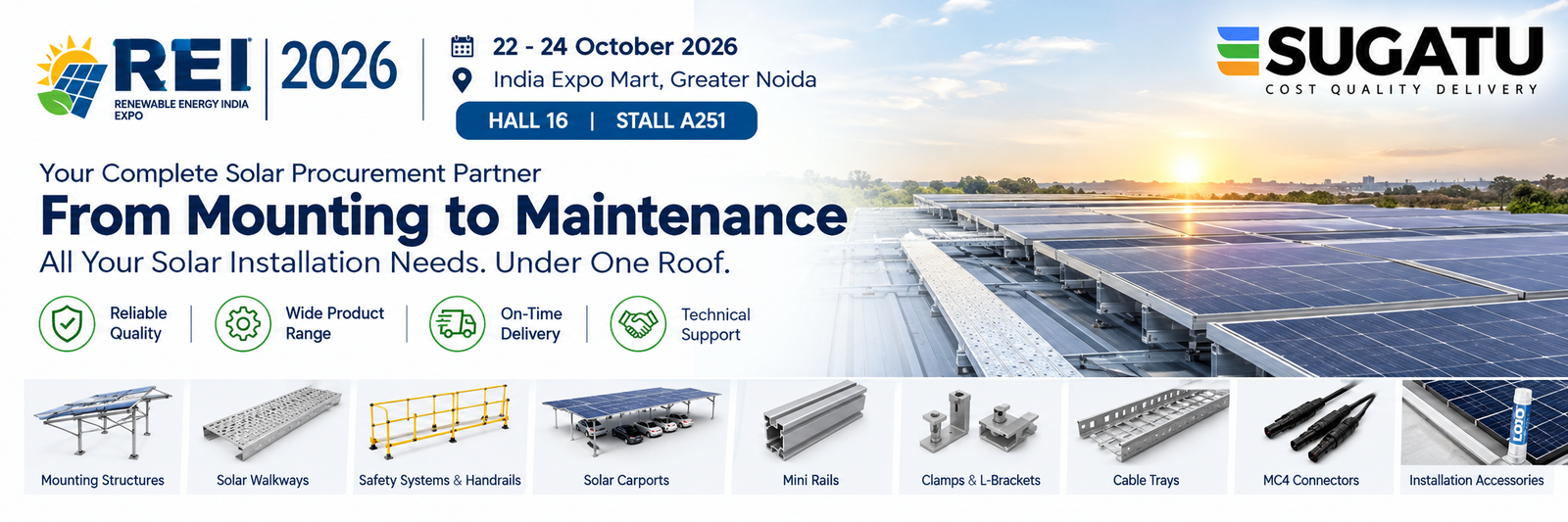
Introduction: Building a Safer and More Efficient Solar Energy Infrastructure in India
India's solar energy sector is experiencing significant growth as businesses, industries, commercial establishments, and infrastructure developers increasingly adopt renewable energy solutions. With rising demand for clean electricity and improved energy efficiency, solar power has become an essential component of modern infrastructure development. However, successful solar power generation depends on more than just high-quality solar panels and inverters. The strength, durability, safety, and performance of a solar installation also depend on the quality of its mounting structures, rooftop access systems, electrical accessories, and installation components.
Solar mounting structures, solar walkways, rooftop safety systems, solar carports, mini rails, aluminium clamps, cable trays, MC4 connectors, and industrial handrails play an important role in creating reliable solar power installations. These components help support solar modules, improve installation efficiency, facilitate maintenance, and enhance worker safety across residential, commercial, industrial, and utility-scale solar projects.
Sugatu Infra Pvt. Ltd. supports the solar industry with products and solutions designed for solar installation requirements. From solar mounting structures and rooftop walkways to fall protection systems and solar mounting accessories, selecting the right components can help solar EPC companies, installers, contractors, and project developers build efficient and dependable solar infrastructure.
This guide explores the importance of solar mounting structures, rooftop solar safety equipment, solar walkways, solar carports, and other essential solar installation accessories while highlighting the factors that businesses should consider when selecting products for their projects.
Understanding Solar Mounting Structures and Their Importance
A solar mounting structure is one of the most important components of a photovoltaic power generation system. It provides the framework required to secure solar panels in the correct position while transferring structural loads to the supporting surface. A properly designed solar panel mounting structure helps maintain panel alignment, withstand environmental conditions, and support the long-term operation of a solar installation.
Solar mounting structures are used in rooftop solar projects, industrial buildings, commercial facilities, ground-mounted solar power plants, and specialised solar applications. Depending on the project requirements, they may be manufactured using galvanised steel, aluminium, or other suitable materials selected for structural strength, corrosion resistance, and environmental exposure.
For solar EPC companies and installation contractors, selecting an appropriate solar mounting system involves evaluating roof type, wind loads, module dimensions, structural requirements, installation conditions, and maintenance accessibility. The mounting system must be compatible with the project design and the solar modules being installed.
High-quality solar mounting structures can contribute to installation stability, efficient assembly, and dependable long-term performance when appropriately engineered and installed. Businesses planning commercial rooftop solar projects should evaluate not only the initial purchase price but also material quality, fabrication standards, installation requirements, and long-term maintenance considerations.
Sugatu Infra Pvt. Ltd. serves the solar infrastructure sector with mounting-related products and installation accessories designed to support different project requirements. Selecting suitable components for each application helps contractors develop solar installations that meet their technical and operational objectives.
Solar Walkway: Improving Rooftop Accessibility and Maintenance Safety
Solar walkways are an important component of rooftop solar infrastructure, particularly in industrial buildings, warehouses, factories, commercial facilities, and large-scale rooftop solar installations. These dedicated walking surfaces provide designated access routes for authorised personnel who need to inspect, maintain, and service solar power systems.
As rooftop solar installations expand, maintenance accessibility becomes increasingly important. Technicians may need to inspect solar modules, check electrical connections, examine cable routing, or perform routine maintenance. Without designated access routes, workers may encounter uneven surfaces, fragile roofing materials, exposed edges, or obstacles around solar equipment.
A properly selected solar rooftop walkway helps establish defined maintenance paths and can reduce the need for personnel to walk directly across unsuitable roof surfaces. It also supports better organisation of rooftop maintenance activities.
Solar walkways are available in different designs and materials depending on roof configuration, loading requirements, environmental conditions, and project specifications. Galvanised steel and other corrosion-resistant materials may be considered where durability and exposure conditions are important. The final selection should account for structural capacity, slip resistance, drainage, fastening methods, and compatibility with the roofing system.
For industrial rooftop solar projects, walkway planning should take place during the design stage rather than after installation. Early planning allows EPC contractors to coordinate walkway routes with solar module rows, cable trays, maintenance zones, and rooftop safety equipment.
Solar walkway systems should form part of a broader rooftop safety strategy. Walkways alone do not eliminate fall hazards or make every roof surface safe to access. Appropriate edge protection, fall protection equipment, safe access arrangements, and project-specific risk assessments remain essential.
For companies searching for a reliable solar walkway manufacturer or supplier in India, it is important to assess product specifications, material quality, fabrication consistency, installation compatibility, and supplier support before making a purchasing decision.
Solar Rooftop Safety Systems: Protecting Workers During Solar Installation and Maintenance
Worker safety is a critical consideration in commercial and industrial solar projects. Rooftop solar installations frequently involve elevated working areas, electrical equipment, roof openings, changing weather conditions, and restricted access zones. These conditions require a carefully planned approach to fall prevention and workplace safety.
Solar rooftop safety systems include products such as safety lines, handrails, guardrails, walkway systems, and compatible fall protection equipment. Depending on the application, these components can help establish safer working routes, protect designated areas, and support controlled access during installation, inspection, and maintenance.
Solar EPC contractors, industrial facility managers, project consultants, and safety professionals should consider rooftop safety requirements during the planning and engineering stages. A well-designed safety arrangement can help identify potential hazards before work begins and establish suitable protective measures for personnel.
The correct safety solution depends on the building layout, roof structure, working conditions, access frequency, applicable regulations, and the tasks that personnel need to perform. Safety equipment should be selected according to its intended application and installed in accordance with manufacturer instructions and relevant safety requirements.
A comprehensive rooftop solar safety plan may include designated walkways, suitable edge protection, engineered anchorage, compatible fall arrest or restraint systems, access controls, warning signs, and worker training. These measures should be selected through a project-specific assessment rather than relying on a single product to address every hazard.
Investing in appropriate rooftop solar safety equipment is also important for maintenance planning. Solar power systems are long-term assets that require periodic inspection and servicing. Providing suitable access arrangements from the beginning can help facility operators plan maintenance activities more effectively.
For industrial and commercial solar installations, the combination of solar walkways, handrails, safety lines, and other appropriate protective measures can contribute to a more organised and safety-conscious working environment.
Solar Safety Line Systems: Supporting Fall Protection on Rooftops
Solar safety line systems are used in suitable applications to support worker fall protection during rooftop installation, inspection, and maintenance activities. Depending on their design, these systems may provide a continuous attachment arrangement that allows trained personnel to remain connected to an engineered fall protection system while moving through designated working areas.
Safety line solutions can be particularly relevant for large industrial rooftops, warehouses, commercial buildings, and utility-related facilities where technicians regularly access elevated work areas.
The suitability of a safety line depends on several technical factors, including the roof structure, anchorage arrangement, system configuration, anticipated loads, number of authorised users, and compatibility with the worker's personal fall protection equipment. The system must be selected and installed according to its intended use and applicable requirements.
Galvanised steel components may be used in certain safety line applications because of their mechanical properties and protective coating. However, corrosion resistance and service life depend on the material specification, coating quality, environmental exposure, installation details, and maintenance practices.
When evaluating a rooftop solar safety line, project teams should review the manufacturer's technical documentation, installation requirements, inspection procedures, and compatibility with the overall fall protection plan. Appropriate user training and periodic inspection are also important for maintaining system reliability.
A safety line should not be treated as a substitute for all other protective measures. Its effectiveness depends on proper engineering, suitable anchorage, correct installation, compatible equipment, and safe working procedures.
For solar EPC companies and industrial facility operators, selecting appropriate solar safety line systems helps integrate worker protection into the overall rooftop solar infrastructure plan.
Solar Handrail Systems: Creating Defined and Protected Working Areas
Solar handrail systems help establish physical barriers around designated access routes, platforms, equipment areas, and other locations where edge protection may be required. They can be used in commercial and industrial rooftop environments where maintenance personnel need clearly defined working areas.
Handrails are available in different configurations and materials depending on the application, structural conditions, environmental exposure, and project specifications. Galvanised steel and aluminium may be considered for particular installations, subject to engineering requirements and compatibility with the supporting structure.
A suitable solar rooftop handrail system should be evaluated for structural strength, fixing arrangements, corrosion resistance, dimensional requirements, and compliance with applicable safety standards. Its design should account for the expected loading conditions and the physical characteristics of the installation site.
Handrails can support safer movement by providing a visible physical boundary around designated areas. They may also help separate maintenance routes from equipment zones and reduce the likelihood of accidental access to restricted areas when correctly designed and installed.
For industrial solar installations, handrail placement should be coordinated with walkways, roof edges, access points, solar module layouts, and maintenance requirements. This coordination can help prevent conflicts between safety equipment and the operational layout of the solar plant.
Businesses evaluating solar handrail suppliers should request relevant product specifications, material information, installation details, and documentation needed to assess suitability for their projects.
When integrated into a properly planned rooftop safety strategy, solar handrails can contribute to safer access and more organised maintenance operations.
Solar Carports: Combining Solar Power Generation with Parking Infrastructure
Solar carports offer an effective way to combine vehicle parking with solar electricity generation. These structures support photovoltaic panels above parking areas, allowing businesses and property developers to use available space for renewable energy production while providing covered parking.
Solar carports are relevant for commercial complexes, industrial facilities, office campuses, educational institutions, hospitals, residential developments, logistics centres, and other locations with substantial parking requirements.
Unlike conventional rooftop solar installations, solar carports require a structural design that accounts for vehicle circulation, parking dimensions, foundation conditions, wind loads, drainage, electrical routing, and the required clearance beneath the structure. The design must also accommodate the weight of the solar modules and the environmental loads applicable to the site.
A well-planned solar carport project begins with a site assessment. Project developers should evaluate the available parking area, orientation, shading, expected electricity demand, vehicle movement, structural configuration, and potential connection to the electrical system.
Solar carports can help organisations make productive use of parking areas while supporting their renewable energy objectives. Depending on the project design, they may also create opportunities to integrate electric vehicle charging infrastructure.
For businesses considering commercial solar carport installation, it is important to work with experienced engineering and solar installation teams. Structural design, foundation planning, electrical safety, drainage, and access requirements should be addressed before construction begins.
Solar carport structures should be designed for the actual site conditions and applicable engineering requirements rather than selected solely on appearance or initial cost.
Sugatu Infra Pvt. Ltd. serves the solar infrastructure market with products and components relevant to solar installation projects. Organisations planning solar carports should evaluate the complete project requirements and select compatible structural and installation components.
Mini Rail Solar Mounting Systems: Efficient Solutions for Suitable Rooftop Applications
Mini rail solar mounting systems are compact mounting solutions used in certain rooftop photovoltaic installations. Their suitability depends on the roof profile, panel arrangement, mounting method, structural requirements, and the specifications of the solar modules being installed.
Compared with some conventional rail configurations, a mini rail system may offer a more compact installation arrangement for compatible roofing applications. Depending on the design, it can help reduce the amount of mounting material required and simplify certain installation steps.
However, mini rail systems are not universally suitable for every roof. The choice between mini rails and conventional mounting rails should be based on roof compatibility, structural performance, wind uplift requirements, module clamping zones, waterproofing considerations, and the manufacturer's installation instructions.
Solar installers should carefully evaluate the roof profile and fixing method before selecting a mini rail mounting system. Incorrect fastener selection, unsuitable attachment points, or inadequate structural assessment can compromise installation performance and roof integrity.
Material selection is also important. Aluminium and other specified materials may be used in different mounting configurations, while fasteners and associated components must be compatible with the application and environmental conditions.
For solar EPC companies handling multiple rooftop projects, standardising suitable mounting components can help improve procurement planning, installation consistency, and inventory management. Nevertheless, each installation must meet the technical requirements of its specific site.
When choosing a mini rail solar mounting system, contractors should assess product quality, dimensional accuracy, material specifications, roof compatibility, and installation documentation.
Solar Clamps and L-Brackets: Small Components with an Important Structural Role
Solar clamps and L-brackets are essential mounting accessories used in many photovoltaic installation configurations. Although these components are relatively small compared with solar panels and mounting structures, they play an important role in securing modules and connecting different parts of the mounting assembly.
Solar panel clamps are commonly used to secure photovoltaic modules to compatible mounting rails. Their design, dimensions, material, and fastening requirements must match the module frame and mounting system.
Incorrect clamp selection can affect module retention, create uneven loading, or damage the module frame. Installers should therefore follow the solar module manufacturer's approved clamping zones and the mounting system manufacturer's installation instructions.
L-brackets are used in suitable applications to connect or support mounting components. Their function depends on the overall structural design, roof configuration, and attachment method. Selecting an appropriate bracket requires consideration of material thickness, dimensions, fastening compatibility, loading conditions, and environmental exposure.
Corrosion resistance is another important factor for solar mounting accessories, particularly in coastal, industrial, humid, or otherwise aggressive environments. The suitability of a material or protective coating should be evaluated against the expected service conditions.
For large solar projects, consistent accessory quality can support installation accuracy and reduce problems associated with incompatible or poorly manufactured components. Procurement teams should verify dimensions, specifications, and compatibility before ordering mounting hardware in bulk.
Solar clamps and L-brackets should always be selected as part of a compatible mounting assembly. Their suitability cannot be established by appearance alone.
Galvalume Solar Walkways: Material Selection for Demanding Rooftop Environments
Galvalume-coated steel is used in a variety of construction and industrial applications because its coating system can provide corrosion protection under suitable conditions. In solar infrastructure, appropriately designed walkway products may be specified for particular rooftop environments.
The suitability of a Galvalume solar walkway depends on the coating specification, base material, thickness, fabrication method, surface design, loading requirements, and environmental exposure. These factors should be assessed together when selecting a walkway for an industrial rooftop solar installation.
Rooftop walkways need to provide an appropriate walking surface and support the expected maintenance loads. Product selection should therefore consider slip resistance, drainage, structural capacity, edge treatment, fixing arrangements, and compatibility with the roof assembly.
The use of a corrosion-resistant material does not eliminate the need for inspection or maintenance. Cut edges, damaged coatings, unsuitable fasteners, trapped moisture, and aggressive environmental conditions may affect long-term performance.
For facility managers and solar EPC contractors, choosing the right walkway involves more than comparing material prices. The product must be suitable for the intended working environment and installed in accordance with the relevant technical specifications.
A properly selected solar walkway can help establish designated maintenance routes and support access planning for rooftop solar installations.
Solar Cable Trays: Organised Cable Management for Photovoltaic Systems
Cable management is an important aspect of solar power system design. Solar installations contain electrical cables that must be routed appropriately between modules, inverters, distribution equipment, and other components. Solar cable trays provide a structured method of supporting and organising cables in suitable applications.
Well-planned cable routing can improve installation organisation, simplify inspection, and make maintenance activities more manageable. Cable trays can also help reduce disorganised cable runs when their layout, support spacing, and installation are properly designed.
The correct cable tray depends on the installation environment, cable types, cable quantities, support requirements, mechanical exposure, and applicable electrical standards. Material selection may vary according to corrosion exposure, installation location, and project specifications.
Solar EPC contractors should coordinate cable tray routes with mounting structures, walkways, access routes, and maintenance zones. Cables should be protected against abrasion, sharp edges, excessive tension, and other foreseeable sources of damage.
Cable trays must not be treated as a replacement for appropriate electrical design. Cable sizing, current-carrying capacity, grounding and bonding requirements, separation, protection, and installation practices must follow applicable standards and manufacturer instructions.
For industrial rooftop solar systems, a well-organised cable management plan can support long-term operational reliability and facilitate troubleshooting.
Businesses sourcing solar cable trays should assess dimensions, material specifications, load capacity, support accessories, finish, and suitability for the intended environment.
MC4 Solar Connectors: Reliable Electrical Connections for Solar Installations
Solar connectors are essential components in photovoltaic systems because they provide electrical connections between compatible modules and associated equipment. MC4-type connectors are widely used in solar installations, but connector compatibility and correct assembly remain important considerations.
Solar connectors must be selected according to their voltage and current ratings, cable specifications, environmental conditions, and compatibility with the connected equipment. The connector manufacturer’s instructions should be followed throughout installation.
One important consideration is that connectors that appear similar are not necessarily approved for interconnection. Mixing connectors from different manufacturers or product families without explicit compatibility approval can lead to poor electrical contact, overheating, moisture ingress, or other failures.
Installers should use compatible connectors and cables, appropriate crimping tools, and the specified assembly procedures. Connections should be protected against moisture, mechanical strain, and other environmental factors in accordance with the product requirements.
Solar connectors also require attention during maintenance. Damaged housings, loose connections, signs of overheating, and improperly assembled components should be evaluated by qualified personnel using appropriate safety procedures.
For solar EPC companies, sourcing connectors from reliable suppliers and verifying product authenticity can support installation quality. Procurement teams should review technical documentation, ratings, compatibility requirements, and applicable certifications before purchasing electrical accessories.
Reliable connector selection and correct installation are important parts of a dependable solar electrical system.
Solar Mounting Accessories: Why Product Compatibility Matters
A solar installation contains multiple interconnected components, and the performance of the complete system depends on the compatibility of these components. Mounting rails, mini rails, clamps, L-brackets, fasteners, walkways, cable trays, and electrical connectors must be selected according to their specific applications.
Using components that are individually well manufactured does not automatically guarantee that they will function correctly together. Dimensional mismatches, unsuitable fasteners, incompatible materials, incorrect installation methods, and inadequate engineering can affect system performance.
For this reason, solar contractors should establish clear product specifications before procurement. Technical requirements may include dimensions, material grades, coating specifications, loading limits, installation procedures, environmental ratings, and compatibility with the selected modules and roof system.
Bulk procurement also requires quality control. Solar EPC companies managing multiple projects should verify product consistency, packaging, traceability where applicable, and delivery requirements. Documentation should be reviewed before components are approved for installation.
A dependable solar component supplier should be able to provide clear product information and help buyers identify the appropriate specifications for their intended applications.
For commercial and industrial solar projects, a coordinated approach to component selection can help reduce procurement errors, improve installation planning, and support more predictable project execution.
Solar Infrastructure for Industrial and Commercial Rooftops
Industrial and commercial rooftops offer opportunities for solar electricity generation, but they also present engineering and operational challenges. Large roof areas may contain skylights, drainage systems, HVAC equipment, electrical installations, access restrictions, and surfaces with different load-bearing characteristics.
Successful rooftop solar development requires coordination between structural engineering, electrical design, mounting system selection, cable routing, access planning, and worker safety.
Solar mounting structures must be compatible with the roof and project loading requirements. Walkways should provide planned access routes. Suitable handrails and fall protection systems should address identified hazards. Cable trays should support organised electrical routing, while mounting accessories must match the selected structural system.
Maintenance requirements should be considered from the beginning. Solar modules, connectors, electrical equipment, and mounting components may require inspection throughout the operational life of the installation. Access arrangements should enable qualified personnel to carry out these activities safely and efficiently.
Industrial facility owners should also evaluate roof condition, waterproofing, drainage, corrosion exposure, and the implications of future roof maintenance before installing solar infrastructure.
For solar EPC companies, integrating these considerations during the design stage can help reduce avoidable conflicts and improve coordination between different project teams.
A carefully planned rooftop solar installation is not simply a collection of panels. It is an integrated infrastructure system in which structural support, electrical design, accessibility, and safety must work together.
How to Choose the Right Solar Products Supplier in India
Selecting a suitable solar products supplier is an important procurement decision for EPC contractors, installers, distributors, and industrial project developers. The right supplier should be evaluated on product suitability, manufacturing or sourcing quality, technical documentation, communication, delivery capabilities, and consistency.
The first consideration is product range. Businesses managing several solar projects may benefit from working with suppliers that offer multiple categories of compatible solar installation products, including mounting accessories, walkways, safety components, cable management products, and other project essentials.
The second consideration is technical suitability. Buyers should confirm product dimensions, material specifications, coating details, load ratings where relevant, and installation requirements before placing an order. Products should match the engineering requirements of the project rather than being selected solely on price.
The third consideration is quality assurance. Procurement teams should request applicable product documentation and verify compliance with project specifications and relevant standards. For critical safety equipment, the required certification, testing, installation, and inspection documentation should be confirmed.
The fourth consideration is supply coordination. Large solar projects may require consistent quantities, defined delivery schedules, and clear communication between suppliers, EPC contractors, and site teams. Delays or incorrect components can affect project schedules.
The fifth consideration is after-sales and technical support. Clear communication about specifications, compatibility, installation requirements, and replacement components can help buyers make informed decisions.
For businesses searching for solar mounting structure suppliers in India, solar walkway suppliers, rooftop safety system providers, or solar installation accessories, a structured supplier evaluation process can improve procurement decisions and reduce project uncertainty.
Sugatu Infra Pvt. Ltd. provides a solar infrastructure product offering for businesses involved in solar installation and project development. Buyers can explore the company's website to learn more about its products and contact the team regarding their project requirements.
Solar Industry Trends: The Growing Importance of Safety, Quality and Efficient Installation
The development of India's solar sector is creating demand for reliable infrastructure components that support efficient installation and long-term operation. As businesses expand rooftop solar capacity and explore new applications such as solar carports, the importance of coordinated engineering and product selection continues to grow.
One important consideration is installation efficiency. Solar EPC companies often manage projects with defined budgets, schedules, and technical requirements. Suitable mounting components and clearly documented installation procedures can help simplify work planning and improve consistency.
Another consideration is rooftop accessibility. As solar installations become more extensive, designated maintenance routes and appropriate safety arrangements become increasingly important for facility operators.
Material durability is also significant. Solar infrastructure is exposed to changing temperatures, rainfall, wind, humidity, dust, and, in some locations, corrosive atmospheric conditions. Selecting materials and finishes appropriate to the environment can support service life when combined with correct installation and maintenance.
Electrical quality remains equally important. Compatible connectors, suitable cables, well-designed cable routing, and appropriate electrical protection contribute to the reliability of photovoltaic installations.
Finally, procurement coordination is essential. Project teams need to ensure that mounting structures, accessories, safety products, and electrical components are available in the correct specifications and quantities.
These considerations highlight why solar infrastructure should be planned as a complete system rather than treated as a collection of unrelated products.
Why Quality Solar Components Matter for Long-Term Project Performance
The long-term performance of a solar installation depends on the combined quality of its design, equipment, installation, operation, and maintenance. While solar panels receive much of the attention, supporting components are essential to the safe and reliable operation of the complete system.
Mounting structures must provide suitable support for the modules. Clamps and brackets must be compatible with the mounting assembly. Walkways and safety systems should address access and fall hazards. Cable trays must support the intended cable arrangement, and electrical connectors must be correctly rated and assembled.
Inadequate product selection can create avoidable maintenance problems, installation delays, or safety concerns. For example, unsuitable fasteners may compromise a mounting connection, incompatible electrical connectors may create electrical hazards, and poorly planned cable routes may make inspection more difficult.
A systematic approach to procurement can help prevent these issues. Project teams should define specifications, review technical documentation, confirm compatibility, inspect delivered materials, and follow approved installation procedures.
Maintenance planning is also essential. Inspections should be performed according to manufacturer recommendations, applicable standards, and site-specific conditions. Any damaged, corroded, loose, or otherwise defective components should be assessed by qualified personnel.
By prioritising suitable products and proper installation practices, solar project developers can support the reliability, maintainability, and safety of their installations over time.
Sugatu Infra Pvt. Ltd.: Supporting Solar Installation and Infrastructure Requirements
Sugatu Infra Pvt. Ltd. serves businesses involved in the solar energy and infrastructure sectors with products intended for solar installation requirements. Its product categories include solar walkways, solar carports, mini rail systems, rooftop safety products, handrails, safety lines, mounting structures, solar clamps, L-brackets, cable trays, and solar installation accessories.
These product categories address different aspects of solar infrastructure, from supporting photovoltaic modules to organising rooftop access and cable management. Selecting the correct products for a particular project requires consideration of the site's structural conditions, technical specifications, environmental exposure, and operational requirements.
Solar EPC companies, contractors, industrial facility owners, distributors, and project developers can explore suitable product options based on their project needs.
For buyers comparing solar walkway manufacturers in India, solar mounting accessories suppliers, rooftop solar safety equipment, or solar infrastructure products, evaluating technical suitability and supplier communication is an important step in the procurement process.
Sugatu aims to serve the solar sector by offering products relevant to installation and infrastructure requirements. Businesses can visit the official website at www.sugatu.in to explore available products and contact the company regarding specific project needs.
Conclusion: Building Better Solar Projects with the Right Infrastructure
India's growing solar energy sector requires more than efficient photovoltaic modules. Reliable solar infrastructure also depends on suitable mounting structures, well-designed rooftop walkways, appropriate fall protection systems, durable mounting accessories, organised cable management, and compatible electrical connectors.
Solar walkways can help establish designated maintenance routes. Handrails and safety line systems can support appropriate rooftop protection when correctly engineered and installed. Solar carports can combine parking infrastructure with electricity generation, while mini rails, clamps, L-brackets, cable trays, and electrical connectors support specific installation requirements.
The key to successful procurement is choosing products that match the project's technical specifications, environmental conditions, structural requirements, and safety needs. Supplier evaluation should consider product quality, compatibility, documentation, delivery coordination, and technical support.
For solar EPC companies, industrial facility managers, contractors, and project developers, taking a comprehensive approach to solar infrastructure can improve project coordination and support long-term operational objectives.
Sugatu Infra Pvt. Ltd. provides products for solar installation and infrastructure applications. To explore product categories and discuss your project requirements, visit www.sugatu.in.
Build your next solar project with a focus on suitable components, dependable installation practices, and safety-conscious infrastructure planning.
