


Solar Consultancy Services in India | Residential & Industrial Solar – Sugatu
Date: 16-11-2026 | Author: Sugatu
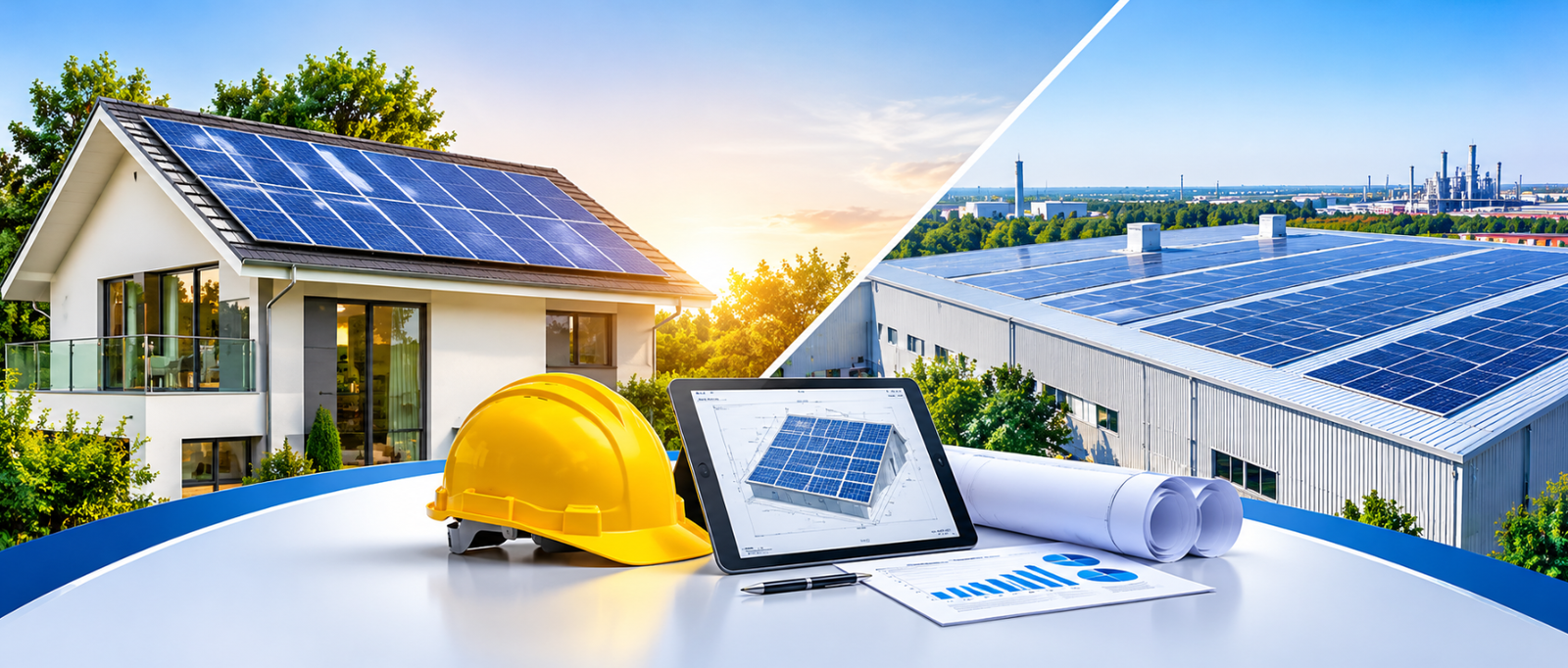
Solar Consultancy Services in India: Expert Guidance for Residential and Industrial Solar Projects
Introduction
India's solar energy sector is expanding as homeowners, commercial establishments and industrial businesses increasingly explore renewable energy solutions. Rising electricity requirements, long-term energy planning and the growing availability of solar technologies have encouraged more consumers and businesses to consider solar power installations.
However, installing a solar power system involves more than purchasing solar panels and mounting structures. Proper planning, technical evaluation, equipment selection and financial analysis are essential for developing a solar installation that meets the energy requirements of the property.
This is where professional solar consultancy services become valuable.
Whether it is a residential rooftop solar system for a home or a large industrial solar installation for a manufacturing facility, expert solar consultation helps property owners understand their energy requirements, evaluate installation feasibility and make informed investment decisions.
Sugatu Infra Pvt. Ltd. offers solar consultancy as part of its solar solutions portfolio, supporting customers exploring residential, commercial and industrial solar projects.
What Are Solar Consultancy Services?
Solar consultancy services involve professional guidance throughout the planning and evaluation stages of a solar energy project.
A solar consultant helps clients understand whether solar power is suitable for their property, what type of system may be required and which technical and financial factors should be considered before installation.
Solar consultancy may involve electricity consumption analysis, rooftop feasibility assessment, solar system capacity planning, equipment recommendations, financial evaluation and project coordination.
The scope of consultancy varies depending on the project's size, location and requirements.
For residential customers, consultancy often focuses on electricity savings, rooftop suitability, system capacity and available government incentives.
For industrial customers, the process may involve more detailed energy consumption studies, load analysis, structural assessments, project feasibility and financial planning.
Residential Solar Consultancy: Planning Solar Power for Your Home
Residential rooftop solar systems allow homeowners to generate electricity using available rooftop space.
However, every household has different electricity consumption patterns, rooftop conditions and financial expectations.
Professional residential solar consultancy helps homeowners evaluate these factors before investing in a solar installation.
Understanding Household Electricity Consumption
The first step in residential solar planning is understanding the household's electricity requirements.
Electricity bills provide useful information about monthly consumption, seasonal variations and overall energy demand.
A solar consultant can review electricity usage and help estimate an appropriate solar system capacity.
For example, a household with relatively low electricity consumption may require a smaller rooftop solar system than a home with multiple air conditioners and higher daytime electricity demand.
System sizing should be based on actual consumption, available rooftop space, applicable regulations and the homeowner's objectives.
Residential Rooftop Feasibility Assessment
Not every rooftop is equally suitable for solar panel installation.
Factors such as roof orientation, available area, shading, structural condition and surrounding buildings can influence the feasibility of a residential solar project.
A rooftop feasibility assessment helps identify suitable installation areas and potential limitations.
The condition and load-bearing capacity of the roof must also be evaluated before installing solar mounting structures.
Proper assessment can help homeowners avoid unsuitable system configurations and unnecessary installation challenges.
Choosing the Right Residential Solar System
Residential solar installations generally include on-grid, off-grid and hybrid system configurations.
An on-grid solar system operates in connection with the electricity distribution network and is commonly considered where grid-connected rooftop solar is permitted.
An off-grid solar system operates independently of the electricity grid and generally requires suitable battery storage and system controls.
A hybrid solar system combines solar generation with compatible battery storage and grid interaction, depending on the system design.
The appropriate option depends on electricity availability, backup requirements, budget and applicable regulations.
Solar consultancy helps homeowners compare these configurations before selecting a system.
Government Subsidies and Residential Solar Schemes
Government incentives can influence the financial feasibility of residential rooftop solar installations.
In India, eligible residential consumers may benefit from schemes such as PM Surya Ghar: Muft Bijli Yojana, subject to current eligibility requirements, approved installation procedures and applicable scheme conditions.
Solar consultancy can help homeowners understand which questions to ask regarding subsidy eligibility, documentation, approved vendors and local distribution company requirements.
Subsidy availability and eligibility should always be verified through official government sources before making financial decisions.
Industrial Solar Consultancy: Solar Solutions for Factories and Businesses
Industrial facilities often have significantly higher electricity requirements than residential properties.
Manufacturing plants, warehouses, processing units, commercial complexes and other businesses may operate energy-intensive equipment for extended periods.
For these facilities, solar power can become an important part of long-term energy management.
However, industrial solar projects require detailed planning because energy consumption patterns, installation areas, structural requirements and financial considerations can be complex.
Professional industrial solar consultancy helps businesses evaluate these requirements before investing in solar infrastructure.
Industrial Energy Consumption Analysis
The first stage of industrial solar consultancy is understanding the facility's electricity consumption.
This may involve reviewing electricity bills, connected loads, operating hours, maximum demand and daytime electricity usage.
Industrial facilities often experience varying electricity requirements depending on production schedules and equipment operation.
A detailed energy assessment helps determine how solar generation could contribute to the facility's overall electricity demand.
It also supports more informed solar system capacity planning.
Industrial Rooftop Solar Feasibility
Factories and warehouses often have extensive rooftop areas that may be suitable for solar panel installation.
However, large rooftop space does not automatically mean that the entire area can be used for solar generation.
Industrial rooftops may contain ventilation equipment, skylights, structural elements and maintenance access requirements.
A solar feasibility assessment considers these conditions along with roof orientation, shading, structural capacity and available installation space.
For metal-sheet roofs and pre-engineered buildings, selecting suitable solar mounting structures and installation methods is particularly important.
Solar System Capacity Planning for Industries
Industrial solar system sizing requires careful evaluation of electricity consumption, available installation area and the facility's operating requirements.
A system that is too small may not meet the project's energy generation objectives, while an oversized system may create unnecessary investment or regulatory challenges.
Solar consultants can help businesses evaluate suitable system capacities based on energy consumption, generation estimates, applicable policies and financial objectives.
The final design should also account for technical requirements, grid connectivity and site-specific conditions.
Financial Feasibility and Return on Investment
Financial evaluation is an important part of industrial solar project planning.
Businesses typically want to understand the estimated installation cost, potential electricity savings, operating expenses and expected payback period.
A solar financial feasibility study may consider project capital expenditure, electricity tariffs, estimated solar generation, maintenance expenses, financing costs and applicable regulatory conditions.
These calculations help industrial customers compare different project configurations and evaluate their potential financial performance.
Actual savings and returns depend on system performance, electricity consumption, tariffs and other project-specific factors.
Residential vs Industrial Solar Consultancy
Although residential and industrial solar projects share several technical principles, their planning requirements can differ significantly.
Residential solar consultancy generally focuses on household electricity consumption, rooftop suitability, installation cost, subsidy eligibility and long-term electricity savings.
Industrial solar consultancy typically involves larger electricity loads, more detailed financial analysis, structural engineering considerations and complex installation requirements.
Industrial projects may also require coordination between facility management teams, electrical engineers, structural consultants and solar EPC contractors.
In both cases, professional consultancy supports informed decision-making and helps identify important technical and financial considerations before installation.
Importance of Solar Site Surveys and Technical Assessments
A solar site survey is an important part of project feasibility evaluation.
For residential projects, the survey may assess rooftop dimensions, orientation, shading, structural condition and available electrical infrastructure.
For industrial projects, the assessment may involve additional considerations such as roof loading, electrical distribution arrangements, equipment locations and maintenance access.
A well-planned site survey provides information needed for preliminary system design and project evaluation.
It also helps identify potential installation constraints before equipment procurement begins.
Choosing the Right Solar Panels, Inverters and Mounting Structures
Equipment selection plays an important role in the performance and reliability of solar installations.
Solar panels should be evaluated according to their electrical specifications, efficiency, warranties and suitability for the proposed installation.
Inverters should be selected based on system configuration, electrical compatibility and operating requirements.
Solar mounting structures must be suitable for the roof profile, structural conditions and applicable design loads.
Other components, including cables, connectors, electrical protection equipment and earthing systems, should be selected according to relevant technical specifications.
Solar consultancy can help clients understand these equipment categories and make more informed procurement decisions.
Solar Consultancy for Rooftop Safety and Maintenance Planning
Long-term maintenance is an important consideration for commercial and industrial rooftop solar installations.
Maintenance personnel may require access to solar panels, electrical equipment and mounting structures for inspection and servicing.
For larger rooftop projects, designated solar walkways can help provide organised access routes.
Additional rooftop safety arrangements, such as safety lines and handrails, may be required depending on the site-specific risk assessment.
Planning these systems during the project design stage can help improve maintenance accessibility and reduce the need for later modifications.
Sugatu's broader solar infrastructure portfolio includes mounting structures, roof maintenance walkways, safety lines and handrail systems.
Benefits of Professional Solar Consultancy Services
Professional solar consultancy provides several advantages for homeowners, industrial businesses and commercial property owners.
One important benefit is better project planning. Technical assessments help identify suitable installation configurations and potential limitations before investment decisions are made.
Another benefit is more informed financial evaluation. Solar consultants can help clients understand project costs, potential electricity savings and relevant financial assumptions.
Consultancy also supports equipment selection by helping customers evaluate different technologies and system configurations.
For larger projects, coordinated planning can improve communication between property owners, engineers, equipment suppliers and installation contractors.
These benefits make solar consultancy an important consideration for customers planning residential and industrial solar installations.
Common Mistakes to Avoid When Planning a Solar Project
One common mistake is selecting a solar system based only on the available rooftop area without evaluating actual electricity consumption.
Another mistake is overlooking shading, roof condition or structural limitations during the planning stage.
Choosing equipment solely on the basis of initial price can also create challenges if product specifications, compatibility and long-term requirements are not adequately considered.
For industrial projects, inaccurate financial assumptions may lead to unrealistic expectations about electricity savings or payback periods.
Finally, failing to plan for inspection and maintenance access can make future servicing more difficult.
A structured solar consultancy process helps identify these issues before installation begins.
Why Choose Sugatu for Solar Consultancy?
Sugatu Infra Pvt. Ltd. offers solar consultancy alongside a range of solar infrastructure products and installation accessories.
Its product portfolio includes solar mounting structures, mini rails, full rails, clamps, roof maintenance walkways, safety lines, handrails, solar carport structures and other solar installation components.
For residential customers, solar consultancy can support the evaluation of rooftop solar requirements, system options and project planning considerations.
For commercial and industrial customers, consultancy can help address broader project requirements, including energy planning, installation feasibility and solar infrastructure selection.
By combining solar consultancy with access to multiple product categories, Sugatu provides a convenient point of contact for customers exploring solar energy projects.
To learn more about residential and industrial solar consultancy solutions, visit www.sugatu.in.
Frequently Asked Questions
1. What is solar consultancy?
Solar consultancy is a professional service that helps homeowners and businesses evaluate, plan and make informed decisions about solar energy projects. It may include energy assessments, feasibility studies, system sizing and equipment recommendations.
2. Why do homeowners need residential solar consultancy?
Residential solar consultancy helps homeowners understand their electricity consumption, rooftop suitability, system capacity, installation requirements and potential financial benefits before investing in solar power.
3. What is industrial solar consultancy?
Industrial solar consultancy involves technical and financial planning for solar installations at factories, warehouses, manufacturing facilities and other commercial or industrial properties.
4. How much solar capacity is required for a house?
The required solar capacity depends on household electricity consumption, available rooftop space, shading conditions, local solar generation potential and applicable regulations. A site-specific assessment is needed for accurate sizing.
5. Is rooftop solar suitable for factories and warehouses?
Many factories and warehouses have rooftop areas that may be suitable for solar installations. However, feasibility depends on structural capacity, roof condition, available space, electricity requirements and other technical considerations.
6. Can solar consultancy help reduce electricity costs?
Solar consultancy can help identify suitable solar configurations and estimate potential electricity savings. Actual savings depend on electricity consumption, solar generation, tariffs, system performance and project costs.
7. What is included in a solar feasibility study?
A solar feasibility study may include electricity consumption analysis, site assessment, shading evaluation, preliminary system sizing, equipment considerations, generation estimates and financial analysis.
8. Is government subsidy available for residential solar installations in India?
Eligible residential consumers may qualify for incentives under applicable government schemes, including PM Surya Ghar: Muft Bijli Yojana. Eligibility and current scheme conditions should be verified through official sources.
9. What is the difference between residential and industrial solar systems?
Residential solar systems are generally designed around household electricity requirements, while industrial solar systems often involve larger capacities, more complex energy consumption patterns and additional technical and financial considerations.
10. Where can I find solar consultancy services in India?
Homeowners, businesses and industrial project developers can explore solar consultancy services offered by companies such as Sugatu Infra Pvt. Ltd. to discuss their solar project requirements.
Conclusion
Solar energy offers opportunities for homeowners and industrial businesses to manage electricity requirements and support long-term renewable energy adoption.
However, the success of a solar project depends on proper planning, technical evaluation, suitable equipment selection and realistic financial expectations.
Residential solar consultancy helps homeowners evaluate rooftop suitability, system capacity and potential electricity savings.
Industrial solar consultancy supports more complex project planning, including energy consumption analysis, structural considerations, system design and financial feasibility.
Sugatu Infra Pvt. Ltd. offers solar consultancy and a range of solar infrastructure products for customers exploring residential, commercial and industrial solar installations.
Planning a residential rooftop solar system or an industrial solar project?
Visit www.sugatu.in to explore Sugatu's solar consultancy services and discuss your project requirements.
